
Subtitle: Why do some older adults remain active and independent, while others become weaker, slower, and more vulnerable to illness? Scientists call this difference frailty.
Introduction
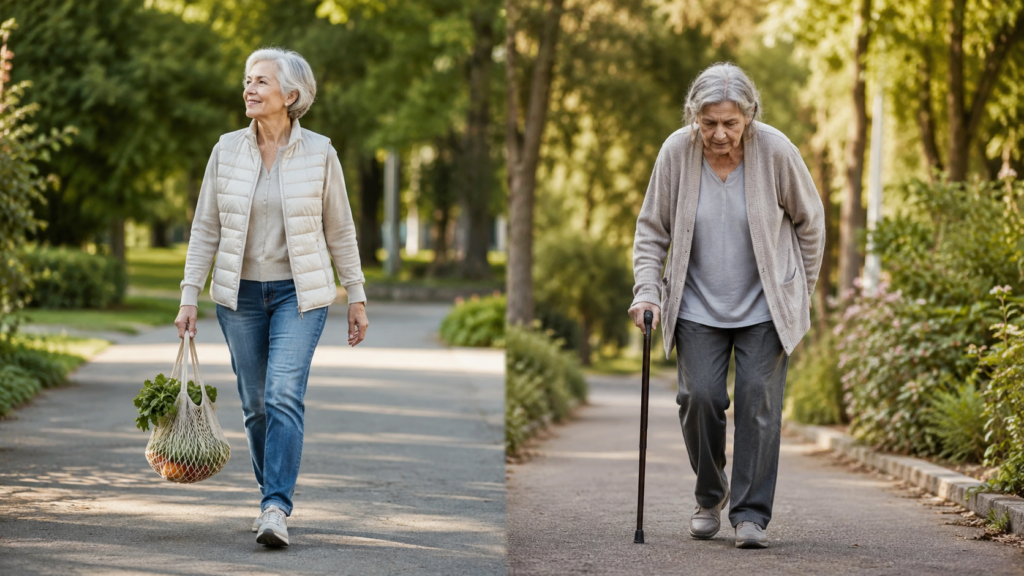
Two people may both be 75 years old.
One still travels, walks every day, carries groceries, and recovers well after a cold. The other becomes exhausted by small tasks, walks more slowly, and may need weeks to recover after a minor illness.
They are the same age, but their bodies do not respond to stress in the same way.
This difference is one reason scientists pay close attention to frailty syndrome. Frailty helps explain why some older adults remain strong and independent, while others become more vulnerable to illness, injury, and loss of function.
Frailty is not simply “getting old.” It is a medical concept used to describe a decline in the body’s strength, energy, and ability to recover.
Understanding frailty is important because it gives us a clearer picture of healthy aging. It shifts the question from “How old is this person?” to “How much reserve does this person’s body still have?”
Frailty Is More Than Simply Growing Older
Aging affects everyone. Over time, the body changes. Muscles may lose some strength. Energy may fluctuate. Recovery may take longer than it did in early adulthood.
But frailty is different from normal aging.
Frailty describes a state in which the body has less physical reserve. Reserve means the extra capacity the body uses when something unexpected happens. This could be an infection, a fall, surgery, emotional stress, or even a few days of poor sleep and reduced food intake.
A person with good reserve may feel tired after the flu but gradually return to normal. A frail person may have a much harder time getting back to their previous level of function.
This is why age alone does not tell the full story. Some people in their 80s remain robust. Some people in their 60s may already show signs of frailty.
Frailty is not a character weakness. It is not laziness. It is not simply a lack of willpower. It reflects changes in the body’s ability to maintain balance under stress.
What Does Frailty Look Like?
Frailty often develops slowly. It may not appear as one dramatic event. Instead, family members may notice small changes over time.
A person may walk more slowly than before. Stairs may feel harder. Carrying shopping bags may become tiring. They may avoid activities they used to enjoy because they feel they do not have enough energy.
Common signs of frailty include:
- reduced strength
- slower walking speed
- fatigue or low energy
- reduced physical activity
- unintentional weight loss
These signs may seem ordinary at first. Many people explain them away as “just aging.” But when several of these changes appear together, they may point to a deeper decline in resilience.
For example, someone may start taking longer to cross the street. Then they may stop going out as often. Over time, they may lose strength because they are moving less. Less movement can then make daily activities feel even harder.
Frailty often works like a slow downward cycle. Small losses can build on each other over months or years.
Why Frailty Matters
Frailty matters because it affects how the body responds to challenges.
Imagine three common situations: recovering from the flu, recovering from surgery, or recovering from a fall.
For a strong and resilient older adult, these events can still be difficult. But with enough reserve, the body has a better chance of returning to its earlier level of function.
For a frail person, the same event may have a much larger impact. A mild infection may lead to confusion, weakness, or loss of mobility. A short hospital stay may make it hard to walk independently afterward. A fall may cause fear, inactivity, and further decline.
This does not mean frail people cannot recover. It means their margin of safety is smaller.
Frailty changes the way stress affects the body. A problem that seems minor in one person may be serious in another because their underlying reserve is different.
This is one reason frailty has become important in aging research. It helps scientists and clinicians think beyond single diseases. Instead of looking only at blood pressure, blood sugar, or one diagnosis, frailty looks at the body’s overall ability to function and recover.
Frailty Does Not Affect Everyone Equally
People age at different rates.
Two people may share the same birthday but have very different biological health. One may have strong muscles, steady balance, good appetite, and high daily activity. The other may feel weak, tired, and unable to handle physical stress.
This difference is sometimes described as biological aging. Biological aging refers to how well the body’s systems are functioning, not just how many years a person has lived.
Frailty is one visible way that biological aging can show up in daily life.
It can affect walking, strength, energy, appetite, and confidence in movement. It can also affect how quickly someone bounces back after illness or injury.
Importantly, frailty exists on a spectrum. People do not usually become frail overnight.
Some may be robust, meaning they have good strength and reserve. Others may be pre-frail, showing early signs such as slower walking or lower activity. Others may be frail, with several signs happening together and a higher risk of poor outcomes.
Thinking of frailty as a spectrum helps remove fear and stigma. It also helps explain why early changes matter.
Why Scientists Pay So Much Attention To Frailty
Frailty has become a major focus in healthy aging research because it is closely linked to important life outcomes.
Researchers study frailty because it can help predict who is more likely to lose independence, experience falls, need hospitalization, develop disability, or have poorer health later in life.
This makes frailty more than a description of weakness. It is a window into the body’s overall resilience.
Frailty also helps researchers understand aging in a more practical way. Many older adults live with more than one health condition. Looking at one disease at a time may miss the bigger picture. Frailty brings together several signals of decline and shows how they affect real life.
For healthy aging science, this is important. The goal is not only to extend lifespan. It is also to understand healthspan: the years of life spent with good function, independence, and quality of life.
Frailty sits at the center of this question. It helps scientists ask why some people remain independent for longer, while others become vulnerable earlier.
Key Takeaways
- Frailty is not the same as normal aging.
- Frailty describes reduced physical reserve and resilience.
- Common signs include weakness, fatigue, slower walking, lower activity, and unintentional weight loss.
- Frailty often develops gradually and exists on a spectrum.
- People of the same age can have very different levels of frailty.
- Frailty has become an important focus in healthy aging research because it is linked to independence, falls, hospitalization, disability, and later-life health outcomes.
Looking Ahead
If frailty develops gradually, why do some people become frail much earlier than others?
Researchers believe several biological processes may contribute. These may include chronic inflammation, reduced repair capacity, changes in muscle health, and aging of the immune system.
These processes do not affect everyone in the same way. They may help explain why two people of the same age can have very different levels of strength, energy, and resilience.
We will explore this question in the next article.
Conclusion
Frailty is not an inevitable outcome of aging.
It is a meaningful medical concept that helps explain why some older adults become weaker, slower, and more vulnerable over time. It also helps scientists understand why chronological age alone cannot predict how well a person will function later in life.
By understanding frailty, we gain a clearer view of healthy aging. We begin to see aging not only as the passing of years, but as a changing balance between stress, recovery, strength, and resilience.
Next Reading
Why Do Some People Become Frail Earlier Than Others?
In the next article, we will explore why aging rates differ, what biological resilience means, and why some people remain robust longer than others.
Previous Article
Why Healthy Living Cannot Fully Stop Aging? You Need to Know
Sources and Further Reading
World Health Organization. Integrated Care for Older People: Guidelines on Community-Level Interventions to Manage Declines in Intrinsic Capacity.
https://www.who.int/publications/i/item/9789241550109
World Health Organization. WHO Clinical Consortium on Healthy Ageing: Topic Focus.
https://www.who.int/publications/i/item/WHO-FWC-ALC-17.2
National Institute on Aging. Frailty Topic Page.
https://www.nia.nih.gov/news/topics/frailty
Fried LP, et al. Frailty in Older Adults: Evidence for a Phenotype. The Journals of Gerontology.
https://pubmed.ncbi.nlm.nih.gov/11253156/
Journal of the American Geriatrics Society. Research Agenda for Frailty in Older Adults.
https://agsjournals.onlinelibrary.wiley.com/doi/10.1111/j.1532-5415.2006.00745.x
The Lancet Healthy Longevity. Recognising Frailty Throughout Adulthood.
https://www.thelancet.com/journals/lanhl/article/PIIS2666-7568(25)00084-4/fulltext
Age and Ageing. Frailty Research and Clinical Aging Publications.
https://academic.oup.com/ageing
Nature Aging. Aging Biology and Healthy Aging Research.
https://www.nature.com/nataging/