
Subtitle:
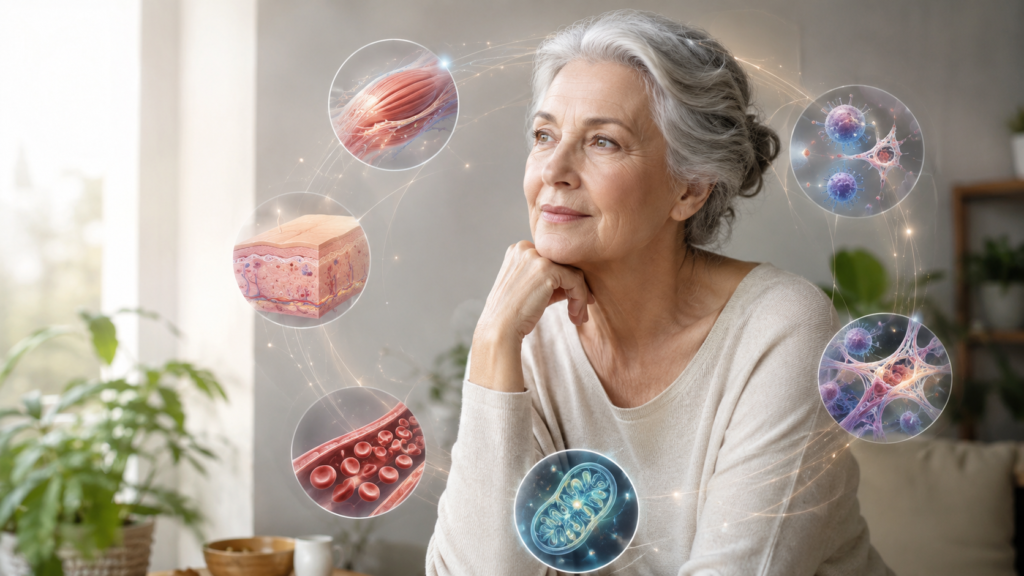
The body is constantly repairing itself. But as we age, these repair systems may become less efficient, making recovery slower and resilience weaker.
Introduction
Many people notice it gradually.
A hard workout may leave soreness for several days. A small cut may take longer to heal. A cold or flu may feel more draining than it once did. After travel, poor sleep, or stress, the body may need more time to feel normal again.
This does not always mean something is wrong. But it raises an important question:
Why does the body take longer to bounce back with age?
One reason is that aging can affect the body’s natural repair capacity. The body still repairs itself, but the process may become slower, less complete, or less coordinated over time.
Repair Is Happening All the Time
Repair is not only needed after injury.
The body is always maintaining itself. Cells are replaced. Damaged materials are cleared away. Muscles respond to use and rest. The immune system watches for problems. Skin, blood vessels, bones, nerves, and organs all require ongoing care.
A simple way to think about it is to imagine the body as a city.
A healthy city needs daily maintenance. Roads need repair. Power systems need monitoring. Buildings need upkeep. Waste must be removed. If maintenance slows down, small problems may begin to accumulate.
The body works in a similar way. Even when we feel well, many quiet repair processes are happening in the background.
After exercise, muscles repair tiny areas of stress. After a cut, skin cells help close the wound. After a cold, the body clears infection and rebuilds energy. After inactivity, muscles need to regain strength.
These are all examples of repair.
Why Repair Becomes Slower With Age
As we age, repair does not simply stop. Instead, many repair-related systems may become less efficient.
Repair signals may become less coordinated. Cells may respond more slowly. Tissues may receive less support from blood flow, oxygen delivery, immune balance, and energy production.
Repair also requires timing. The immune system must respond when needed, then calm down. Blood vessels must deliver oxygen and nutrients. Cells must make new proteins. Damaged material must be removed. Tissues must rebuild their structure.
With age, this coordination may become less precise.
This is one reason recovery may feel different later in life. The body may still know how to repair, but the response may take longer to organize and complete.
What Slower Repair Can Feel Like
Slower repair capacity may appear in everyday life.
Muscle soreness may last longer after exercise. Fatigue may continue after a cold or flu. A small wound may heal more slowly. Energy may take longer to return after stress.
Strength can also change more quickly after inactivity.
For example, a few days of bed rest or reduced movement may lead to noticeable weakness in an older adult. Regaining that strength may take longer than expected. This is partly because muscle repair and rebuilding can become slower with age.
A similar pattern may happen after hospitalization, injury, or illness. Some people return to their previous baseline quickly. Others recover slowly or do not fully regain their earlier strength, mobility, or independence.
These experiences can have many causes. Sudden, severe, or unusual fatigue, weakness, slow wound healing, or loss of function should be discussed with a qualified healthcare professional.
The Role of Inflammation and Immune Balance
Inflammation is part of normal repair.
When the body is injured or fighting infection, short-term inflammation helps bring immune cells to the area. It helps clear damaged tissue and supports healing.
But inflammation needs balance. It should rise when needed and settle down as repair moves forward.
As discussed in the previous article, chronic low-grade inflammation, sometimes called inflammaging, may interfere with healthy repair signals. When inflammatory signals remain active over time, they may make the repair environment less efficient.
This does not mean inflammation is always harmful. Inflammation is essential for healing. The issue is balance, timing, and proper resolution.
Repair Depends on Energy, Blood Flow, and Cells
Repair requires resources.
The body needs energy to rebuild tissue. It needs oxygen and nutrients delivered through the bloodstream. It needs immune coordination. It also needs cells that can produce new proteins, remodel tissue, and support renewal.
Cellular energy is especially important. Repair is active work. Cells must sense damage, communicate, make materials, and restore function. If energy production becomes less efficient with age, repair may become slower.
Blood flow also matters. Good circulation helps deliver oxygen, nutrients, and immune support to tissues. If tissues receive less support, healing and rebuilding may take longer.
Repair also depends on active repair cells. Natural stem cells are one part of this system. They help support tissue maintenance and renewal in certain organs and tissues.
At this stage, it is enough to understand that stem cells are part of the body’s natural repair network. The next article will explore how these cells change with age.
Slower Repair and Reduced Resilience
Resilience is the ability to bounce back after stress.
In healthy aging, stress can mean many things: infection, injury, surgery, poor sleep, inactivity, dehydration, or hospitalization.
A resilient body can respond to stress, repair damage, and return close to baseline. When repair systems become slower or less coordinated, the body may have less reserve.
This helps explain why two people of the same age can recover very differently.
One person may return to normal after an illness within a week. Another may feel weaker for much longer. One person may regain strength after a short hospital stay. Another may lose muscle, mobility, and confidence.
Researchers are studying why these differences occur. Repair capacity, inflammation, immune balance, muscle health, circulation, cellular energy, and overall reserve may all play a role.
Why This Matters for Frailty
Frailty is closely linked to reduced reserve.
A frail body is more vulnerable to stress. A minor illness, fall, or period of inactivity may lead to a larger decline than expected. Recovery may be slower, and the person may be less likely to return fully to their previous baseline.
Slower repair may contribute to this process.
When small stresses happen repeatedly and repair is incomplete, the effects may accumulate. Over time, this may be associated with weakness, fatigue, slower walking speed, reduced activity, and greater vulnerability.
This does not mean frailty is inevitable. It means healthy aging is not only about avoiding disease. It is also about understanding how the body maintains strength, recovers from stress, and preserves independence.
Key Takeaways
- The body is constantly repairing and maintaining itself.
- Repair often becomes slower and less coordinated with age.
- Slower repair may affect recovery after exercise, illness, injury, stress, or inactivity.
- Repair depends on immune balance, blood flow, energy, tissue remodeling, and active repair cells.
- Reduced repair capacity may contribute to lower resilience and may be associated with frailty.
Looking Ahead
If the body’s repair capacity changes with age, one important question is:
What happens to the body’s natural repair cells over time?
Researchers often describe one part of this process as stem cell exhaustion, one of the biological hallmarks of aging.
The next article will explore what natural stem cells do in the body, why they matter for tissue maintenance and repair, and how aging may affect their number, activity, and function.
Conclusion
Slower repair is not simply a matter of “getting older.”
It reflects changes across many biological systems, including immune balance, circulation, cellular energy, tissue renewal, and repair cell activity.
When repair becomes slower, recovery may take longer. Strength may be harder to rebuild. The body may have less reserve after illness, injury, or inactivity.
Understanding repair capacity helps explain why resilience is central to healthy aging. It also helps us see aging as a biological process that affects how the body maintains itself over time.
Next Reading
What Happens to Stem Cells as We Age?
In the next article, we will explore:
- what natural stem cells do in the body
- why they are important for tissue maintenance and repair
- how aging may affect their number, activity, and function
Previous Article
The Remarkable Link Between Inflammation and How You Age
Sources and Further Reading
- National Institute on Aging — Biology of Aging
- World Health Organization — Healthy Ageing and Functional Ability
- The Hallmarks of Aging — Cell
- The Hallmarks of Aging — Nature Reviews Molecular Cell Biology
- The Lancet Healthy Longevity — Intrinsic Capacity and Healthy Ageing
- The Journals of Gerontology: Biological Sciences