
Why is a PET scan expensive? Because you are paying for much more than a few minutes inside a scanner.
In everyday price searches, “PET scan” often refers to PET/CT, where PET imaging is combined with CT. The cost starts before you enter the room. A radioactive tracer has to be prepared and timed for your appointment. Then there is the PET/CT system, a reserved scanner slot, specialist staff, image processing, and the doctor who interprets the study.
That is why two quotations that both say “PET/CT” may not actually include the same examination.
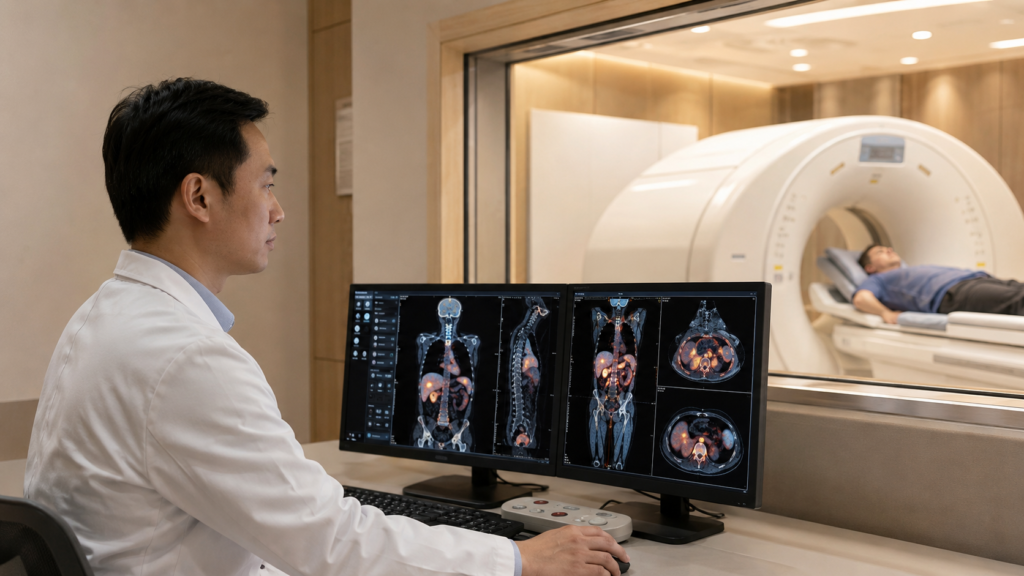
Where Does the Cost of a PET Scan Come From?
A PET/CT price usually has several layers.
| Cost layer | What you are paying for | Why it affects cost |
| Radiotracer | FDG or another radioactive tracer prepared for the examination | The tracer is time-sensitive and may differ by clinical purpose. |
| Reserved PET/CT slot | Access to specialised imaging equipment at a scheduled time | A missed slot can waste both scanner capacity and a prepared tracer. |
| Scan protocol | Body coverage, CT component and contrast when required | Different protocols need different preparation and resources. |
| Specialist workflow | Patient preparation, tracer administration, acquisition and image processing | PET/CT requires coordinated nuclear medicine expertise. |
| Interpretation & report | Specialist review of the PET and CT images | The scan has to be turned into clinically usable findings. |
1. The Radiotracer Starts Decaying Almost as Soon as It Is Made
PET imaging requires a small amount of radioactive tracer.
One of the most widely used tracers is 18F-FDG. It contains fluorine-18, which has a physical half-life of about 109.7 minutes. Its radioactivity therefore falls by half roughly every 110 minutes.
It cannot simply sit on a shelf like an ordinary medicine. Production, delivery, preparation and injection have to be coordinated around the scan.
Different PET studies may also use different tracers. FDG, PSMA and other tracers answer different clinical questions and may have different supply arrangements.
So when two scans have different prices, ask:
“Are they using the same tracer?”
2. A PET/CT Appointment Uses More Than Scanner Time
PET/CT scheduling is less flexible than many people realise.
Singapore General Hospital asks patients to contact the department at least three working days before cancelling or rescheduling. SGH specifically notes that there is a cost attached to both the radioactive tracer and the reserved scanner slot.
There is also usually a waiting period after injection. SGH says the overall process commonly takes three to four hours, including a 60–90 minute uptake period.
The scan itself may be much shorter. But the appointment still requires careful timing and coordination.
Newer equipment can shorten scanning. In 2025, National University Hospital launched Singapore’s first next-generation total-body PET/CT system. NUH says the system can scan in under five minutes in some settings, compared with roughly 8–15 minutes for conventional PET/CT.
But the tracer, preparation, staff and interpretation still remain part of the process.
3. Not Every PET/CT Is the Same Scan
A brain PET/CT, a whole-body study and a specialised PET examination may use different protocols.
The clinical question matters. The body area matters. The tracer matters.
Sometimes the CT component also uses intravenous contrast. That can change the preparation and the final quotation.
This is why “How much is a PET scan?” is sometimes the wrong first question.
A better one is:
“What exact PET/CT protocol am I being quoted for?”
4. You Are Paying for a Specialist Medical Team
A PET/CT is not a self-service machine.
The patient must be prepared, the tracer administered correctly, the imaging protocol followed, and the images processed within a specialised nuclear medicine workflow.
Small differences in preparation and acquisition can affect image quality.
So the scanner model is only one part of what you are paying for.
5. Someone Still Has to Interpret the Images
The machine produces images.
The medical value comes from how those images are acquired, processed and interpreted in the context of the patient’s clinical question.
The final study must be reviewed by appropriately trained specialists and turned into a report that another doctor can use.
When comparing quotations, ask whether specialist interpretation and the final report are included.
What Does a PET/CT Fee Usually Include?
Do not assume every provider packages the same services.
Before booking, confirm whether the quotation covers:
- the radioactive tracer;
- the PET/CT examination;
- the CT component;
- contrast, if required;
- specialist interpretation;
- the written medical report;
- access to the original image files;
- consultation before or after the scan, if needed.
One question can make comparison much easier:
“Is this the total price for the tracer, scan, interpretation and report?”
Why Can One PET Scan Be Much Cheaper Than Another?
A lower price does not automatically mean a lower-quality scan.
A higher price does not automatically mean a better one either.
Prices can differ because of tracer supply, facility costs, staffing, equipment utilisation, scan protocol and the way services are packaged. Different healthcare systems may also price the same service differently.
So the useful question is not only:
“Which one is cheaper?”
It is:
“Am I comparing the same tracer, protocol, interpretation and report?”
What Should You Compare Before You Book?
Before choosing a PET/CT provider, check the details behind the price.
| Question to ask | Why it matters |
| Which tracer is being used? | Different tracers answer different clinical questions and may have different costs. |
| What exact protocol and body area are included? | Two studies both called “PET/CT” may not cover the same examination. |
| Is intravenous contrast included or required? | Contrast can change preparation and the final quotation. |
| Who will interpret the study? | The specialist report is part of the diagnostic service. |
| Are the report and original image files included? | Your own doctor may need both for review or follow-up. |
| Are there consultation or additional fees? | A headline quote may not be the final amount paid. |
If you are now looking for actual local prices, see: PET-CT Cost Compare, Money Saved Can Pay for Fantastic Trips
For healthy people considering PET/CT as part of preventive screening, there is another question first: whether PET/CT is appropriate for you at all. PET/CT is not automatically the right screening test for every healthy person.
See: PET for Healthy Ones: You Need to Know What They Reveal
So, Why Is a PET Scan Expensive?
Because PET/CT combines several costly and time-sensitive parts into one examination.
The tracer has to be timed. The scanner slot has to be reserved. The protocol has to match the clinical question. A specialist team performs the study. And the images still have to be interpreted and reported.
Once you understand those layers, comparing quotations becomes much easier.
If you already have a PET/CT recommendation or quotation, VitaSpan Care can help you compare what is included and review available PET/CT and health-screening options in China where relevant.
Compare the scan before you compare the price.
Related Post: PET-CT Cost Compare, Money Saved Can Pay for Fantastic Trips
Sources
- DailyMed / U.S. National Library of Medicine — Fludeoxyglucose F 18 Injection, USP — physical characteristics and fluorine-18 half-life.
https://dailymed.nlm.nih.gov/dailymed/fda/fdaDrugXsl.cfm?setid=0492cac9-3a81-4cd6-a80d-0b213890e575&type=display - Singapore General Hospital — PET/CT Scans Advisory — tracer injection, uptake period, appointment duration and cancellation guidance.
https://www.sgh.com.sg/our-specialties/nuclear-medicine-and-molecular-imaging/petct-scan - National University Hospital / NUHS — NUH and NUHS Launch New Molecular Imaging and Theranostic Centre — total-body PET/CT system, scan speed and capacity.
https://www.nuh.com.sg/about-nuh/newsroom/newsroom-details/nuh-and-nuhs-launch-new-molecular-imaging-and-theranostic-centre-to-strengthen-patient-care-and-research - National Cancer Centre Singapore — PET Scan in Cancer Diagnosis — PET/CT clinical context and referral information.
https://www.nccs.com.sg/your-care/about-cancer/cancer-tests-and-scans/pet-scan