
Your child has a 20° curve. Another parent says their child also had 20° and was given a brace. So why did your doctor say, “Let’s watch it for now”?
Because the Cobb angle is only part of the decision. A scoliosis brace is used to reduce the risk of curve progression while a child is still growing. Whether it is needed also depends on remaining growth, recent progression, curve pattern and the specialist’s assessment.
The key point: a brace is prescribed when the risk of progression is high enough that bracing is likely to help — not simply because scoliosis exists.
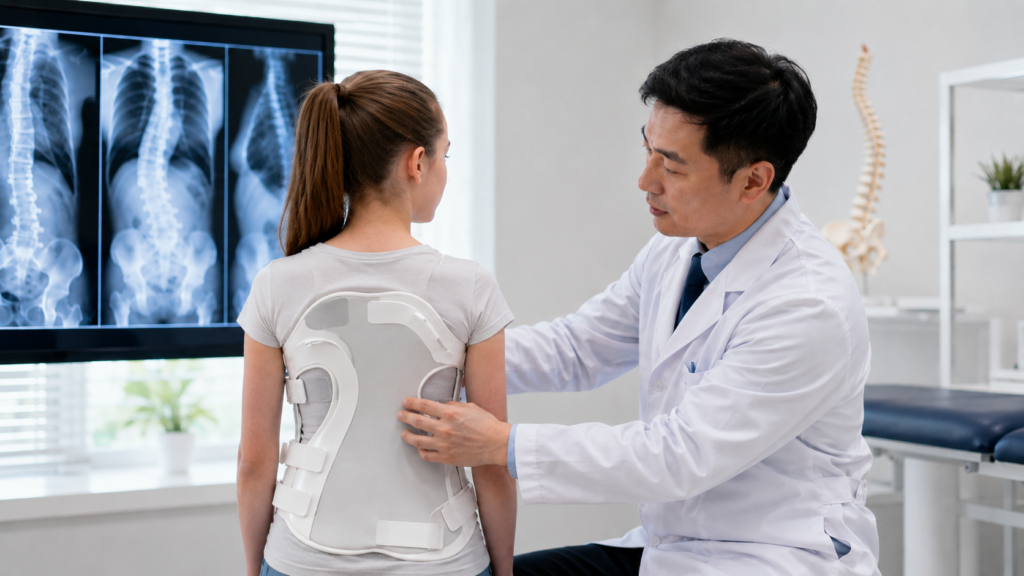
What Does a Scoliosis Brace Actually Do?
A scoliosis brace is designed to control a growing spine and reduce the chance that the curve becomes larger. Its main goal is not to permanently “straighten” the spine. It is to keep the curve from progressing into a more serious range while growth continues.
At What Degree Does a Child Usually Need a Scoliosis Brace?
There is no universal cut-off. The Scoliosis Research Society (SRS) recommends bracing for growing patients with curves larger than about 25° but smaller than about 45° to 50°. AAOS describes bracing as commonly used for growing children with curves around 20° to 40°.
| Cobb Angle | Typical Approach | What Changes the Decision |
| Below 20° | Usually observation | Growth remaining; progression |
| 20°–25° | Observation or bracing may be considered | Rapid growth; progression; maturity |
| 25°–40° | Bracing commonly recommended in growing adolescents | Curve type; flexibility; maturity |
| 40°–50° | Specialist decision; bracing may still be used | Growth; progression; treatment goals |
| Around 50°+ | Surgical evaluation becomes more common | Age; maturity; symptoms; progression |
These are guides, not automatic rules. A stable 20° curve in a nearly mature teenager may be observed, while the same angle in a younger child with documented progression may lead to a different plan.
Why the Same Cobb Angle Can Lead to Different Advice
The brace decision is really a progression-risk decision. Doctors look at:
- how much skeletal growth is left, including maturity markers such as the Risser stage;
- whether the curve has increased on previous X-rays;
- curve location, pattern and flexibility;
- the child’s age and stage of puberty; and
- the starting Cobb angle.
That is why comparing only degrees with another family can be misleading. Two children with the same angle may have very different risks of progression.
Do Scoliosis Braces Really Work?
Yes — for appropriately selected adolescents, bracing has strong evidence for reducing curve progression. In the landmark BrAIST trial, treatment success — reaching skeletal maturity without progression to 50° or more — was more common with bracing than observation. The trial was stopped early because the benefit had become clear.
Brace wear also showed a dose-response relationship: children who wore the brace for more hours generally had better outcomes.
How Many Hours a Day Does a Brace Need to Be Worn?
There is no single schedule. Common daytime braces may be prescribed for roughly 16 to 23 hours a day, while selected curve types may use a night-only brace. The treating specialist and orthotist should set the schedule.
Adherence matters. SRS guidance cites BrAIST data showing much poorer results with very low wear time and success rates of 90% or higher among participants who wore a brace for more than 13 hours a day. Recent sensor-based studies also link greater wear time with less progression.
What Type of Scoliosis Brace Is Used?
A common modern design is the thoracolumbosacral orthosis (TLSO), a molded brace fitted around the torso. Night-only braces can be appropriate for selected flexible curves. The best design depends on curve location, flexibility, rotation, growth and lifestyle, so a brace should be prescribed and fitted by a specialist team.
Can Scoliosis Exercises Replace a Brace?
If a qualified specialist has prescribed a brace, exercise should not be used as a reason to stop wearing it. Scoliosis-specific exercise may be useful alongside bracing, but it has a different role.
For children below the bracing threshold, scoliosis-specific exercise may be considered during observation. For children already braced, exercise can support posture, movement control, muscular balance and function. The two approaches are not competitors. On the question of how we to evaluate if a brace is necessary, Dr Cui Wen can look into details and explain to the parents.
Five Questions to Ask Before Your Child Starts a Brace
- What is the current Cobb angle, and has it changed?
- How much growth does my child have left?
- Why is this brace design right for this curve?
- How many hours should it be worn, and how will progress be checked?
- What outcome would count as successful treatment?
What If Your Child Is Below the Brace Threshold?
Many children with mild scoliosis do not need a brace. Observation is standard care for many smaller curves, but families may still want to understand the curve, growth risk and what can reasonably be done during the waiting period.
If your child already has a recent standing full-spine X-ray, an initial review can help determine whether an in-person assessment and scoliosis-specific exercise programme is likely to be useful. If a brace has already been prescribed, the programme is not intended to replace it.
Learn more: Adolescent Scoliosis Assessment & Exercise Programme
The Bottom Line
A scoliosis brace is most useful when a child is still growing and the curve is large enough — or progressing fast enough — to create a meaningful risk of worsening. Cobb angle matters, but growth and progression determine what that number means. If a brace is prescribed, wearing it as directed matters; if the curve is still mild, observation and an appropriate exercise plan may be the better path.
FAQ
Does a 20-degree scoliosis curve need a brace?
Not always. It may be observed if stable or if little growth remains. Bracing may be considered when substantial growth remains or the curve is progressing.
At what degree is a scoliosis brace usually recommended?
SRS recommends bracing for growing patients with curves above about 25° and below about 45° to 50°. AAOS describes common use around 20° to 40°. Individual decisions vary.
Can a scoliosis brace straighten the spine permanently?
Its main purpose is to prevent progression during growth. Long-term success is usually judged by whether the curve stays controlled through skeletal maturity.
Do back braces help scoliosis?
For appropriately selected adolescents with idiopathic scoliosis, yes. High-quality evidence shows bracing can reduce progression toward a surgical range, especially when worn as prescribed.
Can my child play sports while wearing a brace?
Often yes. Many children remove the brace for approved sports, but the treating specialist should advise how this fits into the daily wear prescription.
Related Reading:
Mild Scoliosis in Teenagers: You Need to Know What to Do
Scoliosis Cobb Angle, You Need to Know What 10°, 20°, 30° Mean
Sources
- Scoliosis Research Society — Bracing
- Scoliosis Research Society — Observation
- American Academy of Orthopaedic Surgeons (AAOS) — Nonsurgical Treatment Options for Scoliosis
- Weinstein SL, et al. Effects of Bracing in Adolescents with Idiopathic Scoliosis. N Engl J Med. 2013 (BrAIST).
- Zapata KA, et al. Outcomes for nighttime bracing in adolescent idiopathic scoliosis based on brace wear adherence. Spine Deform. 2024.
- Linden GS, et al. Early Adherence to Prescribed Brace Wear for Adolescent Idiopathic Scoliosis Is Associated With Future Brace Wear. Spine. 2023.