
If you have learned that insulin resistance may be affecting your health, the next question is natural:
Can it be reversed?
That is the phrase many people search. In practice, “reverse” is not a promise that applies equally to everyone. Insulin sensitivity can often improve substantially, and prediabetes can sometimes return to a normal glucose range, but the result depends on the individual, the severity of metabolic dysfunction and how consistently the underlying risk factors are addressed. [1][2]
The useful question is therefore not “What is the one thing that reverses insulin resistance?” It is “Which changes have the strongest evidence for helping the body respond better to insulin?”
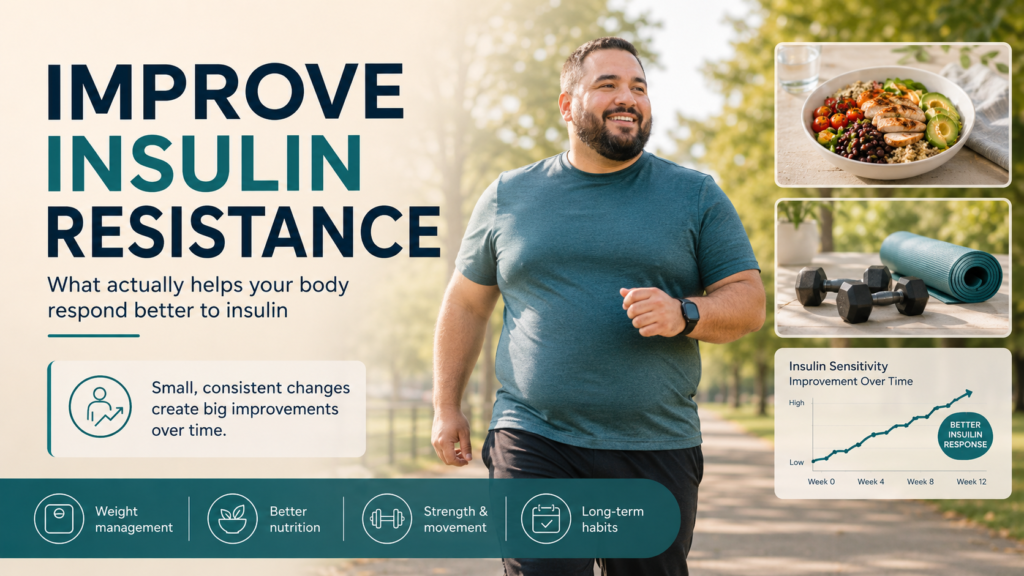
1. Managing Excess Body Fat Can Improve Insulin Sensitivity
For people with overweight or obesity, reducing excess body fat is one of the most effective ways to improve metabolic health. This is especially relevant when fat is concentrated around the abdomen, because visceral fat is closely linked with insulin resistance and cardiometabolic risk.
The important point is that meaningful benefit does not require an extreme transformation. In people at high risk of type 2 diabetes, the Diabetes Prevention Program showed that losing about 5–7% of starting body weight as part of an intensive lifestyle program reduced progression to type 2 diabetes. Current ADA guidance also notes that 5–7% weight loss can improve glycemia and other cardiovascular risk factors, with larger sustained losses often producing greater benefits. [2][3][4]
But the scale is not the whole story. A good weight-management plan also considers waist size, body-fat distribution, muscle mass and whether the weight loss can actually be maintained.
This is why crash diets can be a poor trade-off. Losing weight quickly while sacrificing muscle, energy and long-term adherence may not produce the metabolic outcome a person is looking for.
2. Nutrition Matters, But There Is No Single “Insulin Resistance Diet”
Online advice often reduces insulin resistance to one rule: stop carbohydrates, avoid fruit, fast for long periods, or follow a specific named diet.
The evidence is much less dramatic. ADA guidance emphasizes individualized nutrition rather than one mandatory macronutrient formula. For people who need weight loss, the eating pattern should create an appropriate energy deficit while remaining nutritionally adequate and realistic enough to continue. [4]
In practice, that usually means building meals around a few durable principles:
- Adequate protein to support lean body mass
- More vegetables, legumes, whole grains and other fiber-rich foods where appropriate
- Better carbohydrate quality and smaller amounts of refined carbohydrates and added sugars
- Less reliance on highly processed, energy-dense foods
- Portions and meal patterns that fit the person’s health needs, culture and daily routine
A person with prediabetes, fatty liver, obesity, PCOS or medication use may need a different plan from someone whose only concern is a mildly elevated waist circumference. The best diet is not the most restrictive one. It is the one that improves metabolic risk and can be sustained.
3. Exercise Helps the Body Use Glucose More Effectively — and Muscle Matters
Physical activity improves insulin sensitivity even when weight loss is modest. In the original Diabetes Prevention Program, reaching the physical-activity target was associated with lower diabetes risk even among participants who did not meet the weight-loss goal. [5]
Current ADA guidance encourages about 150 minutes per week of moderate-to-vigorous aerobic activity for most adults with diabetes, and recommends 2–3 resistance-training sessions per week on nonconsecutive days. [6]
Resistance training deserves special attention because skeletal muscle is a major site for glucose use. More active, better-preserved muscle gives the body a larger metabolic ‘sink’ for glucose. ADA notes that resistance training can improve glycemia and cardiometabolic health, and that higher relative muscle mass is associated with better insulin sensitivity and lower diabetes risk. [6]
That does not mean everyone should suddenly start heavy lifting. A person with obesity, joint pain, cardiovascular disease, low fitness or older age may need a gradual plan using walking, cycling, body-weight exercises, resistance bands or supervised rehabilitation.
4. Sleep and Stress Are Not Side Issues
Food and exercise get most of the attention, but sleep is part of metabolic health too.
The 2026 ADA Standards recommend screening sleep health in people with prediabetes or diabetes and in those at risk. Poor sleep and sleep disorders are associated with worse metabolic outcomes, and sleep-promoting routines are part of recommended care. [7]
Chronic stress can also make behavior change harder by affecting appetite, food choices, sleep and the ability to exercise consistently. This is why a metabolic plan that looks perfect on paper may fail if it ignores the person’s actual work schedule, stress load and sleep quality.
5. When Lifestyle Changes Need Professional Support
Many people can make useful changes on their own. But professional support becomes more important when insulin resistance is part of a wider metabolic problem.
Consider a more structured assessment if you have:
- Prediabetes or repeatedly abnormal glucose results
- Obesity or increasing abdominal fat
- Fatty liver or high triglycerides
- PCOS or another condition associated with insulin resistance
- Repeated weight regain despite serious attempts
- Multiple medications or medical conditions that complicate diet and exercise
Professional management can also include medication when appropriate. NIDDK notes that clinicians may prescribe medicines to help manage blood glucose, support weight loss or reduce progression to type 2 diabetes. Medication decisions should be individualized and should complement — not replace — nutrition, physical activity and long-term behavior change. [1]
6. Where a Structured Metabolic Health Program Fits
For some people, the barrier is not knowledge. They already know what they are supposed to do. The problem is doing it consistently while working, traveling, eating in the same environment and repeating the same routines.
A structured program can temporarily change that environment. Assessment, meals, activity, monitoring and professional support can be organized together, making it easier to establish a repeatable routine.
At VitaSpan Care, international clients can begin with a remote multidisciplinary assessment before traveling to China. The team can review existing reports, weight and metabolic concerns, medications and health goals, then discuss whether further testing or an in-person program is appropriate.
For suitable clients, the current 14-day weight-management program in Sanya combines medical assessment, individualized nutrition, supervised aerobic and resistance exercise, body-composition monitoring, behavioral support, accommodation and follow-up. Traditional Chinese Medicine approaches such as acupuncture and massage may be included as complementary care within the broader program, rather than being presented as a substitute for evidence-based metabolic management.
The value of an intensive 14-day period is not that insulin resistance is guaranteed to disappear in two weeks. Its role is to create a medically supervised starting point, identify what needs to change, practice the new routine intensively and leave with a plan that can continue after returning home.
The Bottom Line
Insulin resistance can often improve. The strongest evidence does not point to one supplement, one food or one therapy.
It points to a combination: managing excess body fat when needed, improving nutrition, moving regularly, preserving or building muscle, sleeping better and using medical support when appropriate.
That is also why the three steps in this series matter:
- First, recognize the possible signs.
- Second, confirm the metabolic picture with proper assessment.
- Third, build a plan that addresses the factors you can actually change.
Related Reading: Can’t Lose Weight Anyway?You Need to Know Insulin Resistance
Sources
- [1] NIDDK — Insulin Resistance & Prediabetes
- [2] CDC — Prediabetes: Your Chance to Prevent Type 2 Diabetes
- [3] CDC — What Is the National Diabetes Prevention Program?
- [4] American Diabetes Association — Obesity and Weight Management for the Prevention and Treatment of Diabetes: Standards of Care in Diabetes—2026
- [5] American Diabetes Association — Prevention or Delay of Diabetes and Associated Comorbidities: Standards of Care in Diabetes—2026
- [6] American Diabetes Association — Facilitating Positive Health Behaviors and Well-being to Improve Health Outcomes: Standards of Care in Diabetes—2026
- [7] American Diabetes Association — Sleep Health, Standards of Care in Diabetes—2026