
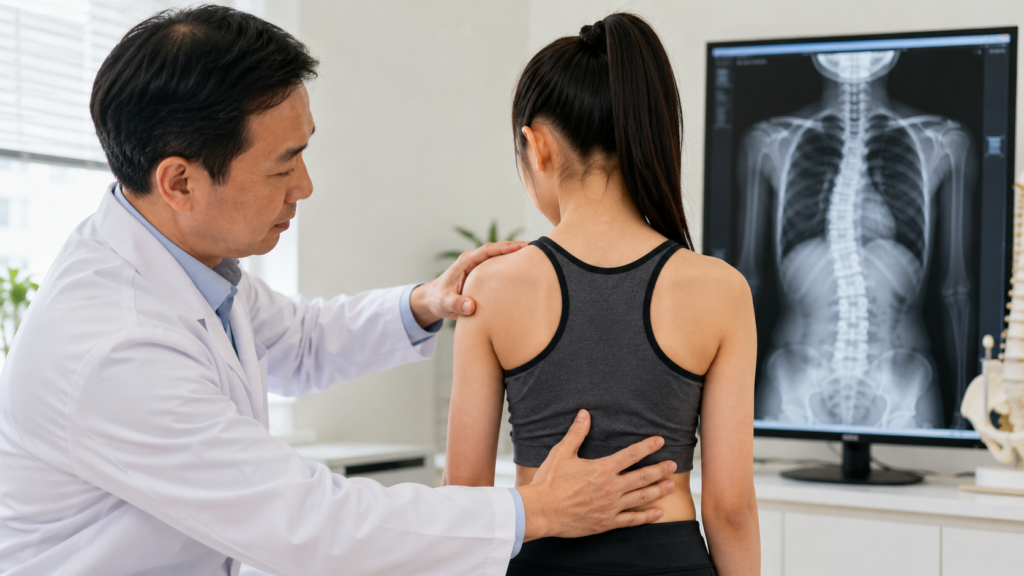
A common scenario: your 13-year-old has a standing spine X-ray. The Cobb angle is 16°. The doctor says the curve is mild and asks you to return in six months.
Naturally, the questions come quickly: Is 16° serious? Can it get worse? Can scoliosis be reversed? Should we be doing something now?
The short answer is this: mild scoliosis is usually not an emergency. But “mild” does not mean “irrelevant,” especially in a child who is still growing. Observation is often medically appropriate, yet observation should still be an active process: understanding the curve, monitoring growth, watching for progression, and deciding whether scoliosis-specific exercises or bracing is appropriate.
What Counts as Mild Scoliosis?
Scoliosis is usually defined as a spinal curve of 10° or more on an X-ray, measured using the Cobb angle. Curves below about 20° to 25° are commonly described as mild, although treatment decisions are not based on the number alone.
The Scoliosis Research Society notes that curves below roughly 25° to 30° are often managed with observation, particularly when they are stable. In growing children, follow-up X-rays may be used every few months to determine whether the curve is progressing.
Is Mild Scoliosis Serious?
Usually, a mild curve does not cause major health problems by itself. Many adolescents with small curves never progress to the point of needing a brace or surgery.
The more important question is not simply, “How many degrees is the curve today?” It is, “How likely is this curve to increase while the child is still growing?”
Progression risk depends on several factors, including the child’s age, remaining skeletal growth, curve pattern, current Cobb angle, and whether previous X-rays already show a change. A 16° curve in a child who is nearly fully grown may be very different from the same 16° curve in a child entering a rapid growth spurt.
Can Mild Scoliosis Get Worse?
Yes, it can — but it does not always do so. Adolescent idiopathic scoliosis tends to progress most during periods of rapid growth. That is why doctors pay close attention to skeletal maturity as well as the Cobb angle.
One commonly used marker is the Risser grade, which estimates skeletal maturity from pelvic X-rays. Lower Risser grades generally indicate more growth remaining. Height changes, puberty stage, and other maturity markers may also help estimate risk.
This is also why “come back in six months” can be a reasonable medical plan. The purpose is not to ignore the curve. It is to see whether the curve remains stable or begins to progress.
Can Mild Scoliosis Be Reversed?
This is one of the most common questions from parents, and the answer needs some nuance.
Scoliosis is a three-dimensional spinal deformity, not simply a posture problem that can be pushed or stretched back into place. Manual therapy, massage, or a single exercise cannot reliably “straighten” the spine.
However, that does not mean nothing can improve. Scoliosis-specific exercise may help posture, trunk control, muscular balance, function, and quality of life. Recent systematic reviews and meta-analyses have also reported modest average improvements in Cobb angle in adolescents who perform Schroth or other scoliosis-specific exercise programmes.
The important word is “specific.” Scoliosis exercise is not just general core strengthening. The exercise direction may depend on the individual curve pattern, trunk rotation, asymmetry, and the way the child compensates.
Does Mild Scoliosis Need a Brace?
Not usually at the lowest Cobb angles. Bracing is generally considered when the curve is larger and the child still has significant growth remaining.
The Scoliosis Research Society states that bracing is commonly recommended for growing adolescents with curves above about 25° and below about 45° to 50°. Smaller curves may also be braced when there is documented progression or substantial growth remaining.
This is why two children with a 20° curve may receive different advice. One may be close to skeletal maturity and remain under observation; another may still have substantial growth left and show clear progression between X-rays.
If a qualified scoliosis specialist has already prescribed a brace, the child should follow that prescription. Exercise may be used alongside bracing, but it should not be treated as a substitute for a medically indicated brace.
So What Can You Do During the “Wait and See” Period?
Observation does not have to mean doing nothing. A useful plan during this period can include:
- Keep the previous X-rays and Cobb angle measurements so that future images can be compared properly.
- Know whether your child still has significant growth remaining.
- Watch for visible changes such as increasing shoulder or waist asymmetry, rib prominence, or trunk shift.
- Maintain normal physical activity unless a doctor has advised otherwise.
- Consider a professional scoliosis assessment if you want to understand the curve pattern and whether scoliosis-specific exercise is appropriate.
- Return for follow-up imaging at the interval recommended by the treating doctor.
Why an Assessment Can Matter Even When the Curve Is Mild
A Cobb angle is important, but it does not describe the whole child. A more complete scoliosis assessment may also consider skeletal maturity, trunk rotation, shoulder and pelvic asymmetry, curve pattern, posture, movement control, pain or fatigue, and any evidence of progression.
Two teenagers can therefore have the same Cobb angle and still need different follow-up plans.
For families who already have a recent standing full-spine X-ray, an initial imaging review can sometimes help determine whether an in-person assessment is likely to add value before making travel plans. On the question of what manual therapy can and cannot do for a growing curve, Dr Cui Wen is direct: it may help with the pain, muscular imbalance and postural loading that accompany a curve, but it does not change the Cobb angle.
Learn more: Adolescent Scoliosis Assessment & Exercise Programme
When Should You Seek Review Earlier?
Do not wait for the next routine appointment if the child develops significant or worsening pain, neurological symptoms such as weakness or numbness, bowel or bladder changes, rapid visible progression, or other symptoms that seem unusual for uncomplicated adolescent idiopathic scoliosis. These features deserve medical review.
The Bottom Line
Mild scoliosis is often managed with observation, and many mild curves never become severe. But the most useful question is not simply whether a curve is “mild.” It is whether the child is still growing, whether the curve is changing, and what the individual progression risk looks like.
For some teenagers, the right plan is simply careful follow-up. For others, scoliosis-specific exercise may be useful. If the curve progresses into a range where bracing is indicated, a brace can play an important role in reducing the risk of further progression.
The goal is not to panic over a small Cobb angle. It is to understand what the number means, monitor it properly, and act at the right time.
Next Reading:
FAQ
Is 15-degree scoliosis serious?
A 15° curve is generally considered mild. The key issue is whether the child is still growing and whether the curve is stable or progressing.
Can 20-degree scoliosis get worse?
Yes. A 20° curve may remain stable, but progression risk is higher when substantial growth remains or when previous imaging already shows an increase.
Can exercise cure mild scoliosis?
Exercise should not be described as a guaranteed cure. Scoliosis-specific exercise may improve posture, trunk control and some clinical outcomes, but results vary and the programme should match the individual curve.
At what degree does a child need a scoliosis brace?
Bracing is commonly considered around 25° and above in a growing child, although smaller progressive curves may also be treated. The decision depends on growth remaining and progression, not just the Cobb angle.
How often should mild scoliosis be checked?
The interval varies by age, growth and progression risk. SRS patient guidance notes that growing children under observation may have X-ray evaluations roughly every 4–6 months in some situations.
Sources
- Scoliosis Research Society — Observation
- Scoliosis Research Society — Bracing
- Scoliosis Research Society — Adolescent Idiopathic Scoliosis
- AAOS OrthoInfo — Scoliosis in Children
- Chen C, Xu J, Li H. Effects of Schroth 3D Exercise on Adolescent Idiopathic Scoliosis: A Systematic Review and Meta-Analysis. Children. 2024.
- Chen J, et al. Schroth Exercise Combined With Brace Treatment for Mild-to-Moderate Adolescent Idiopathic Scoliosis. World Neurosurgery. 2024.
- Peng C, et al. Efficacy of Different Exercises on Mild to Moderate Adolescent Idiopathic Scoliosis: A Systematic Review and Meta-analysis. Am J Phys Med Rehabil. 2024.