
You may have noticed the clues: stubborn abdominal fat, difficulty losing weight, a rising HbA1c, fatty liver, or a strong family history of type 2 diabetes.
But none of these can confirm insulin resistance on their own.
That leads to the next question: is there an insulin resistance test that can give you a clear yes-or-no answer?
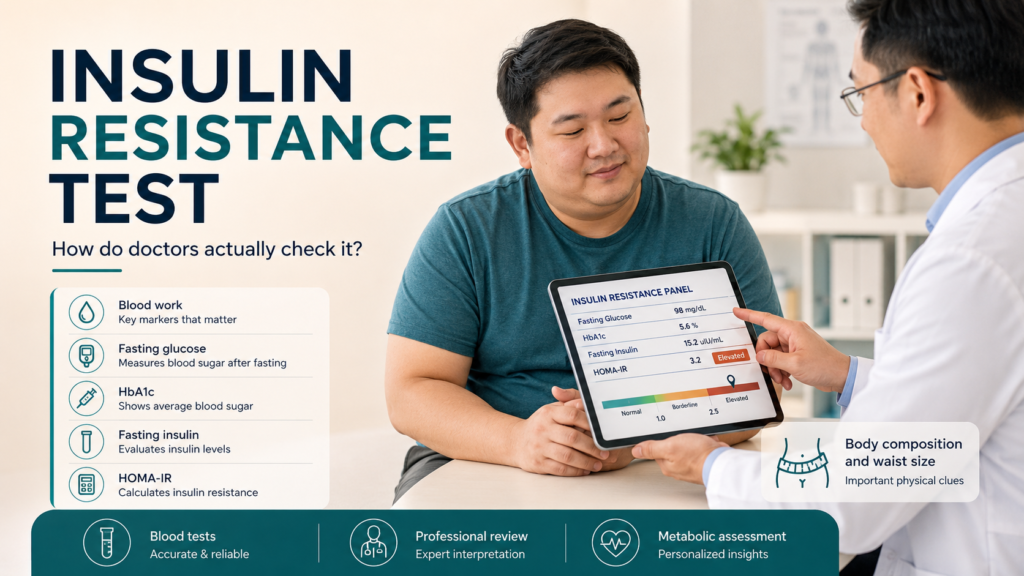
In routine medical care, the answer is more complicated than many online checklists suggest. NIDDK notes that direct testing for insulin resistance is used mainly in research. In everyday practice, clinicians usually evaluate the broader metabolic picture: blood glucose, HbA1c, sometimes insulin-related measures, blood lipids, body composition, waist size, medical history and related conditions. [1]
Why Symptoms Are Not Enough
Insulin resistance often develops before a person feels obviously unwell. The pancreas can compensate for reduced insulin sensitivity by producing more insulin, which may keep blood glucose in a normal range for a period of time.
At the same time, symptoms commonly associated with insulin resistance – fatigue, cravings, weight gain or difficulty losing weight – are nonspecific. They can also occur with poor sleep, stress, medication effects, thyroid disease, anemia and many other conditions.
So the goal of testing is not to prove that one symptom equals one diagnosis. It is to look for objective evidence of abnormal glucose regulation or wider metabolic risk, and to interpret that evidence in context.
What Tests Are Used to Evaluate Insulin Resistance?
There is no single routine clinical test that captures insulin resistance perfectly. Instead, doctors may use several measures that answer different questions.
1. Fasting Plasma Glucose: What Is Your Blood Sugar Right Now?
A fasting plasma glucose test measures blood glucose after at least eight hours without calories. It is widely available and commonly used to screen for prediabetes and diabetes.
According to NIDDK and the American Diabetes Association (ADA), a fasting glucose of 100-125 mg/dL falls in the prediabetes range, while 126 mg/dL or higher meets the diabetes threshold when appropriately confirmed. [2][3]
Its limitation is equally important: it is a snapshot. A normal fasting glucose does not automatically prove that insulin sensitivity is normal, especially earlier in the process.
2. HbA1c: What Has Your Average Glucose Looked Like?
HbA1c reflects average blood glucose over roughly the previous two to three months and does not require fasting. An A1c of 5.7-6.4% is in the prediabetes range, while 6.5% or above meets the diabetes threshold when confirmed under standard diagnostic rules. [2][3]
HbA1c is useful because it looks beyond one morning’s glucose level. But it also has limitations. Certain conditions that affect red blood cells or hemoglobin can make A1c less reliable, and different glucose tests do not always identify exactly the same people. [3]
3. Oral Glucose Tolerance Test: How Does Your Body Handle a Glucose Load?
An oral glucose tolerance test (OGTT) measures how the body handles a standardized glucose drink. Blood glucose is checked after fasting and again after the drink, commonly at two hours.
For nonpregnant adults, a two-hour glucose of 140-199 mg/dL is in the prediabetes range, while 200 mg/dL or above meets the diabetes threshold when confirmed. [2][3]
The OGTT can detect impaired glucose tolerance that fasting glucose or HbA1c may miss, but it takes more time and is less convenient, so it is not always the first test used.
4. Fasting Insulin and HOMA-IR: Useful, But Not a Universal Diagnostic Cutoff
This is where many online discussions become confusing.
Fasting insulin can show how much insulin the body is producing while fasting. HOMA-IR combines fasting insulin and fasting glucose to estimate insulin resistance. These measures can be useful in research and may provide additional context in selected clinical settings.
However, there is no universally accepted HOMA-IR cutoff that works for every person or population. Results vary with age, sex, ethnicity and the laboratory insulin assay used. A recent review of insulin-resistance biomarkers also notes that the lack of standardized insulin measurement limits HOMA-IR’s routine clinical interpretation. [4]
That means a HOMA-IR number found on the internet should not be used as a stand-alone self-diagnosis.
5. The Metabolic Context: Lipids, Waist, Body Composition and Liver Health
Insulin resistance rarely exists in isolation. Clinicians may also look for the metabolic pattern that often travels with it.
- Waist circumference and abdominal fat distribution
- Body composition and overall weight trend
- Triglycerides and HDL cholesterol
- Blood pressure
- Fatty liver or abnormal liver-related findings
- PCOS, sleep apnea and other associated conditions
Prediabetes itself is commonly associated with abdominal obesity, higher triglycerides, lower HDL cholesterol and hypertension. Looking at these factors together helps turn isolated numbers into a more useful risk assessment. [1][3]
Why Professional Interpretation Matters
Imagine two people with the same fasting glucose. One has a normal waist size, normal lipids and no family history. The other has increasing abdominal fat, fatty liver, high triglycerides and a parent with type 2 diabetes. The same glucose number does not create the same clinical picture.
Professional interpretation also matters because the standard tests answer different questions. Fasting glucose reflects one point in time. HbA1c reflects longer-term average glucose. The OGTT tests the response to a glucose challenge. Fasting insulin and HOMA-IR can provide additional information but lack a universal diagnostic threshold.
So a good assessment is less about chasing one perfect number and more about asking: Is glucose regulation beginning to change? Are metabolic risks clustering together? Is there prediabetes or diabetes that needs formal diagnosis? And what should happen next?
Can You Start With an Online Metabolic Assessment?
For an international patient, professional assessment does not necessarily mean booking a flight first.
If you already have recent laboratory results, imaging reports, medication lists or a health-screening report, an online multidisciplinary review can be a practical starting point. The team can review what information is already available, identify gaps, discuss your weight and metabolic concerns, and determine whether additional laboratory testing or an in-person evaluation would be useful.
At VitaSpan Care, international clients can start with a remote MDT assessment before traveling to China. This is best understood as a pre-assessment and planning step – not an online diagnosis based on one number. Where appropriate, the review can help clarify what should be checked next and whether a structured in-person weight-management or metabolic-health program may fit the person’s needs.
What Happens After Insulin Resistance or Prediabetes Is Identified?
Testing should lead to a decision, not just another number in a report.
If the assessment suggests insulin resistance, prediabetes or a cluster of metabolic risks, the next step usually focuses on the factors that can be changed: weight management when appropriate, nutrition, physical activity, muscle-preserving resistance exercise, sleep, and medical management when needed.
That is the next part of this series: what actually helps improve insulin sensitivity, and which changes matter most?
The Bottom Line
If you suspect insulin resistance, there is no single routine blood test that gives every person a simple yes-or-no answer.
Fasting glucose, HbA1c and OGTT are established tools for identifying prediabetes and diabetes. Fasting insulin and HOMA-IR may add context in selected settings, but they should not be interpreted using a universal internet cutoff. The most useful approach is professional assessment of the full metabolic picture.
Next Reading: How to Reverse Insulin Resistance: What Actually Helps Improve Metabolic Health