
One shoulder looks slightly higher. One side of the waist seems deeper. A T-shirt suddenly hangs unevenly. These small changes are often how scoliosis is first noticed – not because a teenager complains of pain.
Adolescent idiopathic scoliosis often develops during the years of rapid growth, and mild curves can be surprisingly easy to miss. The good news is that most visible asymmetry does not mean a severe spinal problem. But if several signs appear together, or the asymmetry seems to be increasing, it is worth having the spine properly assessed.
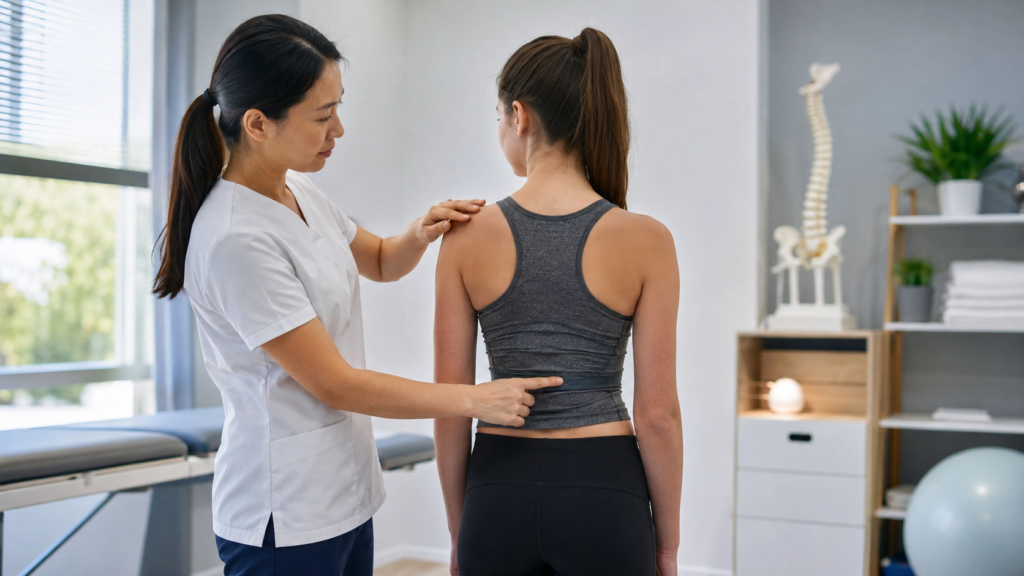
What Are the Most Common Scoliosis Symptoms?
Scoliosis is a three-dimensional change in the spine: it curves sideways and also rotates. Because of that rotation, the first signs are often seen in the shoulders, ribs, waist or the way the body sits over the pelvis rather than as an obvious S-shaped spine.
1. One shoulder sits higher than the other
Uneven shoulder height is one of the most recognizable signs. The difference may be subtle and easier to notice in photographs, swimwear or fitted clothing than in everyday loose clothes.
2. One shoulder blade looks more prominent
A shoulder blade may appear to stick out more on one side because the rib cage and trunk rotate with the spinal curve.
3. The waist looks uneven
One side of the waist may have a deeper crease, or the space between the arm and the waist may look different from side to side.
4. One hip appears higher or more prominent
Pelvic and trunk asymmetry can make one hip look higher, even when the legs themselves are the same length.
5. The ribs stick out more on one side
A rib prominence or “rib hump” is particularly important because it reflects trunk rotation. It often becomes more visible when the teenager bends forward.
6. The body seems to lean to one side
The head or torso may not appear centered over the pelvis. Sometimes the whole trunk seems shifted slightly left or right.
7. Clothes suddenly hang unevenly
Parents sometimes notice that a hemline looks tilted, one trouser leg seems different, or a shirt twists to one side. Clothing fit is not a diagnostic test, but it can be a useful clue when combined with other asymmetries.
Does Scoliosis Usually Cause Back Pain?
Not necessarily. Many teenagers with adolescent idiopathic scoliosis have little or no pain, especially when the curve is mild. The Scoliosis Research Society notes that back pain is common in teenagers in general and is not necessarily caused by the spinal curve itself.
That is why waiting for pain is not a reliable way to detect scoliosis. Visible asymmetry may appear before a teenager feels anything unusual.
A Simple Clue: the Forward Bend Test
When scoliosis is suspected, clinicians commonly use the Adams forward bend test. The teenager bends forward at the waist while the examiner looks from behind for asymmetry in the ribs or lower back. A scoliometer may be used to measure trunk rotation.
Parents can notice asymmetry during a forward bend, but the test is only a screening clue. It cannot tell you the Cobb angle, and it cannot confirm scoliosis on its own.
So How Do You Know If You Actually Have Scoliosis?
The diagnosis is confirmed with clinical assessment and, when appropriate, a standing full-spine X-ray. The X-ray allows the clinician to measure the Cobb angle. A curve of 10 degrees or more is generally used as the radiographic definition of scoliosis.
The assessment may also look at skeletal maturity, curve pattern, trunk rotation, shoulder and pelvic balance, and whether previous imaging shows progression. These details matter because a mild curve in a teenager who has almost finished growing is different from the same curve in a younger child with substantial growth remaining.
When Should Parents Get It Checked?
If you consistently notice uneven shoulders, a rib prominence, a shifted waist, or several of the signs above, arranging a professional assessment is reasonable – especially while the child is still growing.
You do not need to assume the worst. Many mild curves only require observation. The purpose of assessment is to determine whether scoliosis is actually present, how large the curve is, and whether the child has meaningful risk of progression.
Some Symptoms Deserve Faster Medical Review
Typical adolescent idiopathic scoliosis is often painless and does not usually cause neurological symptoms. Seek medical review promptly if spinal asymmetry is accompanied by unusual or significant features such as:
- persistent or severe pain, especially pain that wakes the child at night
- weakness, numbness, tingling or changes in walking
- bowel or bladder changes
- rapidly increasing deformity
- breathing difficulty or other significant systemic symptoms
These symptoms do not automatically mean something dangerous is present, but they are not features that should simply be watched at home.
Should Every Teenager Be Screened for Scoliosis?
This is more complicated than it sounds. The U.S. Preventive Services Task Force has concluded that evidence is currently insufficient to determine the overall balance of benefits and harms of routine screening in all asymptomatic adolescents.
That does not mean visible signs should be ignored. The recommendation applies to routine screening of adolescents without symptoms or obvious deformity. A teenager with clear asymmetry, abnormal imaging, pain or other concerning findings should be clinically evaluated.
If Scoliosis Is Found, What Happens Next?
The next step depends on the Cobb angle, remaining growth and whether the curve is changing. A small, stable curve may simply be monitored. Scoliosis-specific exercise may be considered in selected teenagers. Bracing is more commonly discussed when a growing adolescent reaches a higher Cobb-angle range or shows progression. Larger curves may require specialist surgical review.
In other words, spotting an uneven shoulder does not tell you the treatment. It tells you that the spine may be worth checking. Alternatively, you can consult Dr Cui Wen online for more advice.
Already Have a Recent Spine X-ray?
If your child already has a recent standing full-spine X-ray, an initial imaging review can help clarify the Cobb angle, curve pattern and whether an in-person assessment or scoliosis-specific exercise programme is likely to add value.
Learn more: Adolescent Scoliosis Assessment & Exercise Programme
The Bottom Line
Scoliosis in teenagers is often first noticed through asymmetry, not pain. One higher shoulder, a more prominent shoulder blade, an uneven waist or a rib hump during forward bending can all be clues.
None of these signs can diagnose scoliosis by themselves. But if the asymmetry is consistent – particularly during a growth spurt – a proper assessment can answer the questions that appearance alone cannot: Is there a true spinal curve? What is the Cobb angle? Is the child still growing? And does the curve need observation, exercise, bracing or specialist treatment?
FAQ
What is usually the first sign of scoliosis?
Uneven shoulder height, a prominent shoulder blade, waist asymmetry or a rib prominence are common early clues. Mild scoliosis may not cause pain.
How do you know if your teenager has scoliosis?
Visible asymmetry can raise suspicion, and the Adams forward bend test can reveal trunk rotation. Diagnosis is usually confirmed through clinical assessment and a standing spine X-ray when indicated.
Can scoliosis be present without back pain?
Yes. Many teenagers with adolescent idiopathic scoliosis have no significant pain, particularly when the curve is mild.
Does one uneven shoulder always mean scoliosis?
No. Posture, muscle imbalance and other factors can also create asymmetry. Persistent or increasing asymmetry should be assessed rather than self-diagnosed.
When is an X-ray needed for suspected scoliosis?
A clinician may request a standing full-spine X-ray when examination suggests a structural curve. The X-ray confirms the diagnosis and allows the Cobb angle to be measured.
Sources
- Scoliosis Research Society – Adolescent Idiopathic Scoliosis
- NHS – Scoliosis
- United States Preventive Services Task Force – Adolescent Idiopathic Scoliosis: Screening
- Great Ormond Street Hospital – Idiopathic scoliosis and spinal surgery
- Coventry & Rugby GP Gateway – Paediatric Scoliosis referral guidance (reviewed 2025)
Medical note: This article is for general education and does not replace diagnosis or treatment by a qualified scoliosis specialist.