Your child has been told they have scoliosis. The next thing many families do is search for exercises. Core exercises. Stretching. Pilates. YouTube routines. Schroth exercises.
It is easy to come away with the impression that the right workout can simply “straighten” the spine. That is not how scoliosis works.
The short answer: exercise can be useful, especially when it is scoliosis-specific and matched to the individual curve. But exercise is not a guaranteed cure, and general strengthening is not the same as scoliosis-specific treatment.
For teenagers with mild or moderate adolescent idiopathic scoliosis, the aim is often to improve postural control, trunk symmetry, strength and function — and, in selected patients, to help limit progression while growth continues.
What Are Scoliosis-Specific Exercises?
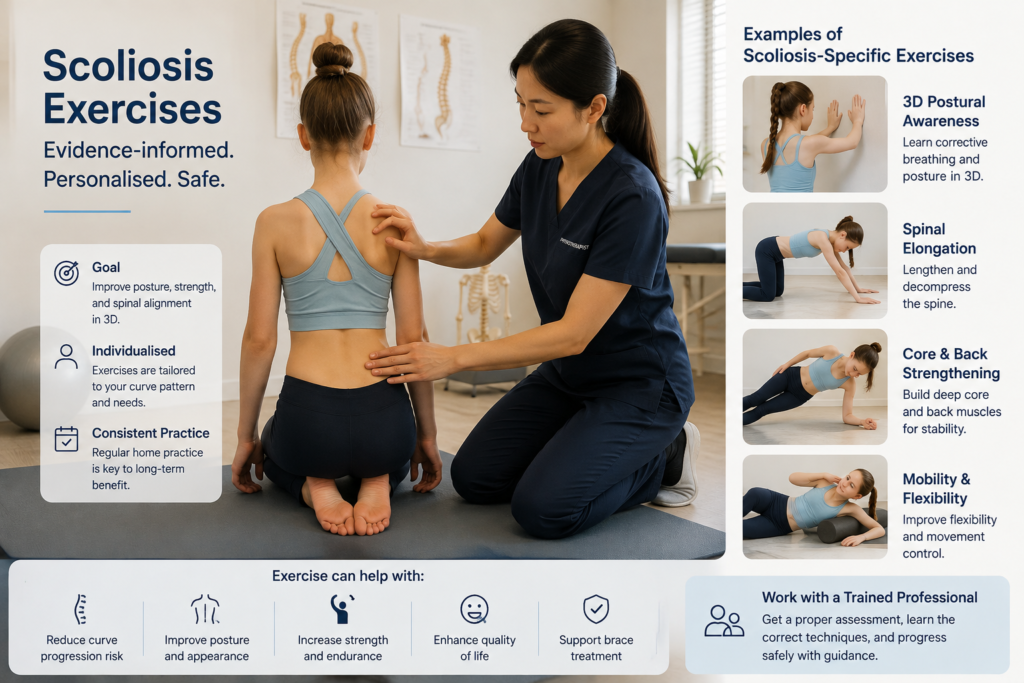
Physiotherapeutic scoliosis-specific exercises (PSSE) are different from a generic back workout. They are designed around the three-dimensional nature of scoliosis and the individual child’s curve pattern.
The SOSORT guidelines describe PSSE as including three-dimensional self-correction, training in daily activities, stabilization of the corrected posture and patient education. They also recommend that programmes be individualized and taught by therapists specifically trained in the approach they use.
Schroth is the best-known PSSE approach, but it is not the only school of scoliosis-specific rehabilitation. The important point is not the brand name. It is that the exercise is selected and corrected for the actual curve rather than copied from a general exercise list.
Do Scoliosis Exercises Actually Work?
The evidence is encouraging, but it does not support promises that exercise will reverse scoliosis.
A 2024 Cochrane review found the evidence limited by small studies, varied programmes and short follow-up, and called for better long-term research.
Several newer reviews nevertheless report modest average improvements in Cobb angle, trunk rotation and quality of life with PSSE or Schroth-based programmes. A 2024 pediatric Schroth review found stronger support for trunk rotation and posture than for some larger clinical outcomes.
So the practical message is neither “exercise does nothing” nor “exercise can straighten every scoliosis curve.” A better description is: appropriately prescribed scoliosis-specific exercise can be a useful part of conservative care for selected adolescents.
Why “10 Best Exercises for Scoliosis” Can Be Misleading
Scoliosis is not the same in every teenager. Curves can be thoracic, lumbar or thoracolumbar. They can bend and rotate in different directions, and the shoulders, ribs and pelvis can compensate differently.
That means an exercise that helps one child learn better three-dimensional correction may not be the right correction strategy for another child.
This is why the first question should not be, “What is the best exercise for scoliosis?” It should be: “What is this child’s curve pattern, and what are we trying to improve?”
What About Core Exercises, Back Strengthening and Stretching?
Core and back strengthening
Core exercises and back strengthening can improve general strength, endurance and movement control. One randomized trial comparing Schroth with core stabilization found that both approaches had benefits, but Schroth produced greater improvements in several scoliosis-specific outcomes, while core stabilization was better for some strength measures.
So core training can be useful — but “stronger core” should not be confused with “scoliosis correction.”
Stretching and mobility
Stretching may be included to address stiffness, breathing mechanics or movement restrictions, but stretching alone is not a proven way to correct a structural scoliosis curve. In a scoliosis-specific programme, mobility work is usually chosen to support the particular correction strategy.
Pilates or yoga
Pilates and yoga can be excellent forms of general exercise for strength, flexibility and body awareness. However, they should not automatically be treated as scoliosis-specific therapy. A teenager who enjoys them may often continue, but a therapist may modify particular movements depending on the curve, symptoms and treatment goals.
Sports and normal activity
Having scoliosis does not usually mean a teenager should stop being active. In uncomplicated adolescent idiopathic scoliosis, normal sport and physical activity are generally encouraged unless the treating clinician has given a specific restriction. Sport is healthy — it is simply not a substitute for scoliosis-specific treatment when treatment is indicated.
Can Exercises Straighten the Spine?
Exercise may improve some measurements in some adolescents, but it cannot be guaranteed to make the spine straight.
Research commonly reports group averages of a few degrees of Cobb-angle improvement. That is useful scientific information, but it does not mean every child will improve by the same amount. Cobb-angle measurement itself also has several degrees of normal measurement variability.
A good programme therefore looks beyond one number. It may track trunk rotation, posture, shoulder and waist symmetry, function, confidence, symptoms and whether the curve remains stable during growth.
Can Exercise Replace a Scoliosis Brace?
No — not when a brace has been medically indicated. If a scoliosis specialist has prescribed bracing because the curve and growth stage meet bracing criteria, exercises should not be used as a reason to stop or reduce brace wear without medical advice.
SOSORT recommends scoliosis-specific exercise during brace treatment, which means the two can complement each other. They are not interchangeable treatments.
Can Scoliosis Exercises Be Done at Home?
Yes — home practice is often an important part of treatment. But the safest model is usually “learn first, practise second.”
A therapist can assess the curve, teach the intended correction, check breathing and alignment, and confirm the child can reproduce it correctly. A written or video-supported home programme can then support regular practice.
For information on suitable home practice methods for children, you can also consult Dr Cui Wen online for targeted guidance.
What Should a Good Scoliosis Exercise Programme Include?
- A review of the standing full-spine X-ray and Cobb angle
- Assessment of curve pattern, trunk rotation and visible asymmetry
- Consideration of skeletal maturity and how much growth remains
- Individualized three-dimensional correction rather than generic exercises alone
- Clear one-to-one teaching so the teenager knows what the correct position feels like
- A practical home programme that can realistically be repeated
- Follow-up to check technique, adherence and whether the curve remains stable
Already Have a Recent Spine X-ray?
If your child already has a recent standing full-spine X-ray, the first step can be to understand the curve before choosing exercises. An initial review can help determine whether an in-person scoliosis assessment and individualized exercise programme is likely to be useful.
Learn more: Adolescent Scoliosis Assessment & Exercise Programme
The Bottom Line
Exercise has a real place in adolescent scoliosis care, but not all exercise is the same. Core strengthening, stretching, Pilates and sport can all support general health. Scoliosis-specific exercise goes a step further by matching correction strategies to the individual three-dimensional curve.
For a teenager with mild scoliosis, that may be a useful way to stay active and work on posture and control while the curve is monitored. For a child who needs a brace, exercise may support treatment but should not replace it.
The goal is not to find a magical movement on the internet. It is to understand the curve, learn the right movement correctly, and use exercise as part of an appropriate plan.
FAQ
What are the best exercises for scoliosis?
There is no single best exercise for every curve. Physiotherapeutic scoliosis-specific exercises such as Schroth are individualized according to curve pattern and are better aligned with scoliosis treatment goals than a generic exercise list.
Are core exercises good for scoliosis?
Core exercises can improve strength and movement control, but core strengthening alone is not the same as scoliosis-specific correction.
Can scoliosis exercises straighten the spine?
Some studies report modest average improvements in Cobb angle and trunk rotation, but exercise cannot guarantee that a structural scoliosis curve will become straight.
Can scoliosis exercises be done at home?
Yes. Home practice is common, but the exercises should ideally be taught and checked first so the teenager understands the correct three-dimensional movement.
Is Pilates good for scoliosis?
Pilates may support general strength, flexibility and body awareness, but it is not automatically a scoliosis-specific treatment. Individual modifications may be appropriate.
Should a teenager stop sports because of scoliosis?
Usually not. Normal physical activity is generally encouraged in uncomplicated adolescent idiopathic scoliosis unless the treating clinician has given a specific restriction.
Sources
- Cochrane Review (2024) — Therapeutic exercises for idiopathic scoliosis in adolescents
- SOSORT Guidelines — Orthopaedic and rehabilitation treatment of idiopathic scoliosis during growth
- JBJS Reviews (2024) — The Schroth Method for Pediatric Scoliosis: A Systematic and Critical Analysis Review
- American Journal of Physical Medicine & Rehabilitation (2024) — Efficacy of Different Exercises on Mild to Moderate Adolescent Idiopathic Scoliosis
- Spine Deformity (2024) — Impact of patient scoliosis-specific exercises for adolescent idiopathic scoliosis
- Clinical Rehabilitation — Schroth vs core stabilization exercise randomized trial
- PLOS ONE — Schroth PSSE added to standard care and Cobb angle outcomes
Medical note: This article is for general education and does not replace diagnosis or treatment by a qualified scoliosis specialist or physiotherapist.