
You cut back on snacks. You start walking more. Maybe you even add strength training. But your waistline barely changes.
Could insulin resistance be part of the reason? Possibly. But difficulty losing weight by itself does not mean you have insulin resistance. Weight can also be affected by food intake, sleep, medications, hormones and activity level.
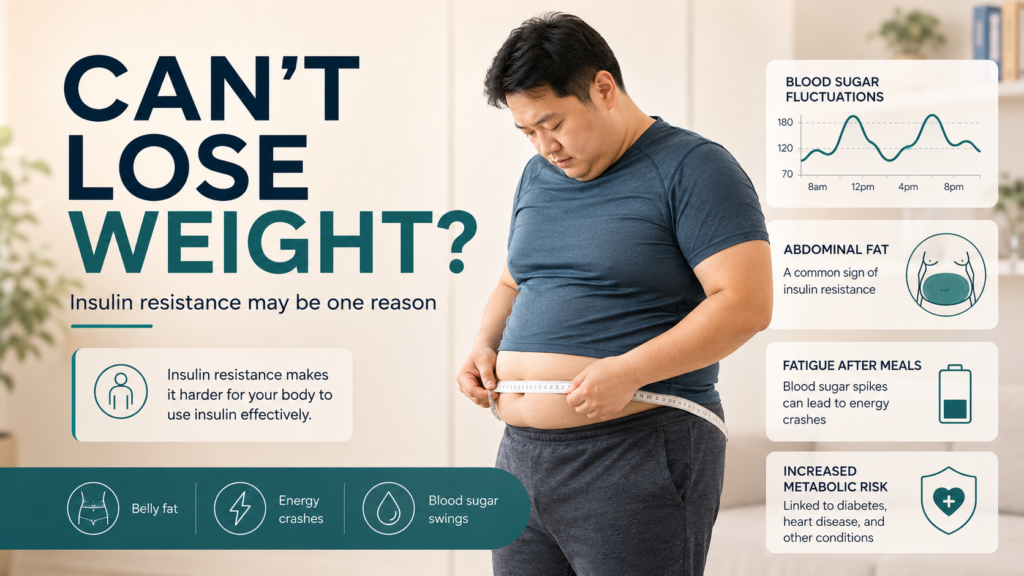
It is one metabolic factor worth checking when stubborn weight appears alongside a large waist, abnormal blood sugar, fatty liver, PCOS or a family history of type 2 diabetes.
What Is Insulin Resistance?
Insulin is a hormone made by the pancreas. After you eat, it helps glucose move from the bloodstream into muscle, fat and other cells, where glucose can be used or stored for energy.
With insulin resistance, cells in the muscles, fat and liver do not respond to insulin as effectively as they should. The pancreas may compensate by producing more insulin to keep blood glucose within a normal range. This is one reason insulin resistance can develop quietly: your blood sugar may still look normal for some time while the body is working harder to maintain that balance. [1]
Over time, if the body can no longer compensate effectively, blood glucose may begin to rise. That can progress to prediabetes and, in some people, eventually type 2 diabetes. Importantly, insulin resistance and prediabetes often cause no obvious symptoms. [1]
Common Insulin Resistance Symptoms — Or Clues Worth Checking
The phrase “insulin resistance symptoms” is searched frequently, but medically it can be misleading. Most people do not have a clear symptom pattern. It is more useful to think in terms of clues and risk signals rather than a checklist that can diagnose you.
1. A Larger Waist or More Abdominal Fat
A large waist size and excess body fat — particularly fat stored around the abdomen — are strongly associated with insulin resistance and prediabetes. That does not mean belly fat proves you have insulin resistance. It means the combination is common enough that clinicians consider waist size and weight when assessing metabolic risk. [1][2]
This also explains why some people first encounter the term insulin resistance while trying to understand why weight management has become more difficult.
2. Difficulty Losing Weight
Insulin resistance can occur alongside weight gain, and excess weight can also worsen insulin resistance. The relationship can therefore run in both directions. [1]
Still, a weight-loss plateau is not a diagnostic sign. Poor sleep, medications, menopause-related changes, thyroid problems, stress, muscle loss or an unsustainable diet can all affect progress. If weight remains unusually difficult to manage despite consistent effort, insulin resistance may be one factor to investigate — not the only explanation.
3. Hunger, Fatigue or Energy Swings
Some people investigate blood-sugar problems because they feel unusually hungry, tired or low in energy. These experiences are highly nonspecific: poor sleep, anemia, stress, under-eating and medications can produce similar symptoms.
So feeling sleepy after lunch or craving carbohydrates is not enough to conclude that you are insulin resistant. These sensations only become more meaningful when they appear together with stronger metabolic risk factors or abnormal test results.
4. Dark, Velvety Skin in Body Folds
One more specific physical clue is acanthosis nigricans: darker, thicker, velvety skin that often appears around the neck, armpits or groin. It can be associated with insulin resistance, obesity and diabetes, although it can also occur for other reasons. [3]
If this kind of skin change is new or unexplained, it is worth discussing with a healthcare professional rather than treating it as a cosmetic issue only.
5. Abnormal Metabolic Test Results
Often, the first objective clue is not a symptom at all. It is a routine health check showing higher fasting glucose, a rising HbA1c, high triglycerides, low HDL cholesterol, fatty liver or a combination of metabolic risk factors. NIDDK notes that insulin resistance and prediabetes can occur together with abnormal cholesterol and triglyceride levels, large waist size, high blood pressure and metabolic fatty liver disease. [1]
Who Is More Likely to Develop Insulin Resistance?
Weight is only part of the picture. NIDDK lists several factors that can increase the chance of insulin resistance or prediabetes, including overweight or obesity, a large waist, increasing age, family history of diabetes, physical inactivity, previous gestational diabetes, PCOS, sleep apnea and some long-term medications. [1]
You also do not have to “look overweight” to have a metabolic problem. A normal BMI does not rule out risk related to genetics, body-fat distribution, medical conditions or medication use.
Conditions that often travel with insulin resistance include PCOS, fatty liver disease and metabolic syndrome. If one of these has already been identified, it is reasonable to ask whether your glucose and broader metabolic health should also be reviewed. [1][2]
Can Symptoms Confirm Insulin Resistance?
No — and this is one of the most important points in this article.
Many people with insulin resistance have no symptoms at all. At the same time, many people who have fatigue, cravings or difficulty losing weight do not necessarily have insulin resistance.
That is why an online symptom checklist should be treated as a prompt to investigate, not a diagnosis. Clinicians look at the whole picture: medical history, weight and waist trends, blood pressure, glucose-related tests, blood lipids and other metabolic indicators. [1]
The next step is therefore not to label yourself. It is to decide whether proper metabolic testing and professional interpretation are warranted.
What Should You Do If You Suspect Insulin Resistance?
Start with what you already know. Gather recent blood-test results and note changes in weight or waist size, family history, medications and conditions such as PCOS or fatty liver.
Then discuss the pattern with a qualified healthcare professional. A professional assessment can help distinguish insulin resistance or prediabetes from other reasons you may be struggling with weight or energy.
For international clients considering a structured weight-management or metabolic-health program in China, VitaSpan Care can arrange a remote multidisciplinary review before travel. The purpose of that first step is not to diagnose you from a video call, but to review your concerns and existing information and decide what further evaluation may make sense.
The Bottom Line
If losing weight feels unusually difficult, insulin resistance may be worth investigating — but it is only one possible explanation.
The strongest clue is rarely one symptom. What matters is the pattern: body composition, metabolic risk factors, medical history and objective test results.
If you suspect insulin resistance, the next question is simple: how is it actually checked?
Next Reading: How Doctors Check Insulin Resistance? You Need to Know