
When most people hear the words “PET scan,” they think of cancer patients.
That raises an obvious question: if you feel healthy and have no known tumour, why would PET/CT or PET/MR ever appear in a health screening package?
Here is the direct answer: PET can sometimes reveal abnormal metabolic activity before a disease causes symptoms or becomes clearly visible on conventional imaging. This gives PET potential value in early detection, particularly for people with elevated cancer risk or unexplained findings. However, it is not a universal cancer screening test, and most healthy adults do not need it as a routine annual examination.
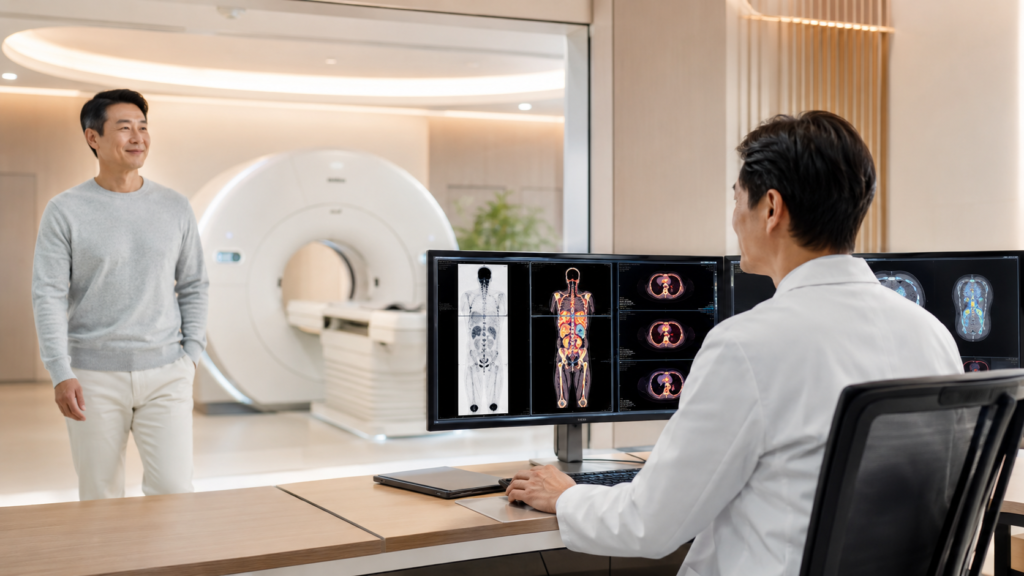
What Does a PET Scan Actually See?
CT and MRI mainly show anatomy: the size, shape and structure of organs and tissues.
PET adds a different type of information. It uses a small amount of radioactive material, known as a radiotracer, to show biological activity inside the body.
The most widely used tracer is 18F-FDG, a substance similar to glucose. Because many cancer cells consume glucose at a high rate, they may appear as areas of increased activity on a PET scan.
This is why PET is often described as functional or metabolic imaging. It may identify changes at the cellular level before a mass becomes clearly visible on CT or MRI.
PET is not limited to cancer. Depending on the tracer and the clinical question, it may also be used to evaluate the brain, heart, inflammation and infection.
Why Is PET So Closely Associated With Cancer?
PET/CT is especially valuable after cancer is suspected or diagnosed.
Doctors may use it to:
- locate a suspected tumour;
- determine whether cancer has spread;
- establish the stage of the disease;
- assess whether treatment is working;
- investigate possible cancer recurrence.
In these situations, the scan answers a defined medical question. Its findings may directly influence treatment decisions, such as whether surgery, radiotherapy or systemic treatment is appropriate.
That is different from scanning someone who has no symptoms and no known abnormality.
Can PET Detect Cancer Before Symptoms Appear?
Sometimes, yes.
Whole-body PET imaging can examine a large part of the body during one appointment. Studies in asymptomatic populations have shown that it can detect some previously unknown cancers, including cancers found at relatively early stages.
A recent systematic review and meta-analysis found that FDG PET-based imaging has potential for whole-body cancer screening. However, the evidence does not currently support routine PET screening for everyone in the general population.
This distinction matters.
A test may be capable of finding cancer without being proven to improve outcomes when routinely offered to every healthy person.
An effective screening test should do more than detect abnormalities. It should find disease early enough to improve treatment outcomes while keeping false alarms, unnecessary procedures and other harms acceptably low.
Why PET Is Not a Universal Cancer Radar
A Bright Area Is Not Automatically Cancer
FDG may also collect in areas affected by inflammation, infection, recent surgery, muscle activity or some benign conditions.
An abnormal PET finding may therefore lead to repeat imaging, specialist consultations, endoscopy or biopsy before doctors can determine what it means.
In other words, PET may find something important—but it may also find something that looks concerning and later turns out not to be cancer.
A Normal PET Scan Does Not Exclude Every Cancer
Some tumours are too small to be detected. Others grow slowly or do not absorb much FDG.
PET may also be less effective for certain cancers and anatomical areas. Research has identified limitations in detecting small cancers, low-metabolism tumours and some urinary system cancers.
PET therefore cannot replace established screening methods such as:
- mammography or breast MRI when indicated;
- cervical cancer screening;
- colonoscopy or other colorectal screening;
- low-dose chest CT for eligible high-risk smokers;
- prostate assessment;
- targeted ultrasound, MRI or endoscopy.
Different tests are designed to find different diseases.
More Detection Does Not Always Mean Better Health
All screening tests can produce false-positive results, false-negative results, overdiagnosis and unnecessary treatment.
Finding an extremely slow-growing abnormality may not necessarily help someone live longer. Meanwhile, additional tests caused by an uncertain finding can create cost, anxiety and medical risk.
This is why the most advanced scan is not automatically the most appropriate scan.
What About Radiation?
A PET scan uses a radioactive tracer.
PET/CT adds radiation from the CT component. The actual dose varies depending on the equipment, scanning range and whether the CT is used only to locate PET findings or as a full diagnostic examination.
PET/MR combines PET with MRI instead of CT. MRI does not use ionising radiation, so PET/MR avoids the radiation produced by the CT component. However, PET/MR is not completely radiation-free because the PET radiotracer is still required.
PET/MR may provide detailed images of soft tissues, including the brain, liver and pelvis. It is also less widely available, usually takes longer and is often more expensive.
Most importantly, lower radiation does not automatically make PET/MR an appropriate routine screening test for every healthy person.
Who Might Reasonably Discuss PET With a Doctor?
PET-based screening or diagnostic imaging may be more relevant when there is a specific reason to investigate further, such as:
- a strong family history of cancer;
- a known inherited cancer risk;
- a previous cancer diagnosis;
- an unexplained abnormality found during another examination;
- persistent symptoms without a clear explanation;
- a suspicious mass or laboratory result;
- concern that disease may involve several areas of the body.
Some of these situations are no longer ordinary health screening. They are diagnostic investigation or cancer surveillance.
For a low-risk person with no symptoms, established age- and risk-based screening usually remains the more evidence-based starting point. Research has suggested that PET/CT may have greater potential in carefully selected high-risk groups than in the general asymptomatic population.
PET/CT or PET/MR: Which Is Better?
Neither is automatically better. They answer slightly different imaging questions.
PET/CT is more widely available, generally faster and often useful for examining the lungs, bones and overall distribution of disease.
PET/MR avoids radiation from the CT component and provides excellent soft-tissue detail. It may be considered for selected neurological, abdominal, pelvic or paediatric cases.
The choice should be based on what doctors are trying to find—not on which machine sounds newer or more advanced.
The Better Question to Ask
Instead of asking:
“Can I add PET to my check-up?”
Ask:
“Based on my age, family history, previous results and personal risk, is PET likely to find information that would change what we do next?”
For some people, the answer may be yes.
For many healthy adults, a well-designed screening plan combining laboratory tests, ultrasound, targeted CT or MRI, endoscopy and sex-specific screening may provide more useful information with fewer unnecessary findings.
The most comprehensive health screening is not the one containing the greatest number of advanced machines.
It is the one designed around the person being examined.
Considering Deeper Health Screening?
VitaSpan Care can help coordinate a personalised health screening in Shanghai.
PET/CT, PET/MR and whole-body MRI may be considered as optional add-ons based on your age, family history, medical history and previous test results.
Start by telling a coordinator what you are concerned about. The screening institution can then assess which examinations may be appropriate, instead of automatically placing the most expensive technology into every package.
This article is intended for general education and does not replace individual medical advice.
Related Post: PET-CT Cost Compare, Money Saved Can Pay for Fantastic Trips
Sources
RadiologyInfo.org. MRI Safety.
https://www.radiologyinfo.org/en/info/safety-mr
RadiologyInfo.org. PET/CT — Positron Emission Tomography/Computed Tomography
https://www.radiologyinfo.org/en/info/pet
National Cancer Institute. Cancer Screening Overview (PDQ®) — Patient Version
https://www.cancer.gov/about-cancer/screening/patient-screening-overview-pdq
Das KJ, et al. Applicability and Performance of 18F-FDG PET-Based Modalities for Whole-Body Cancer Screening: A Systematic Review and Meta-Analysis.
https://pubmed.ncbi.nlm.nih.gov/39302525/
Tong J, et al. Cancer Screening of Asymptomatic Individuals Using 18F-FDG PET/CT in China: A Retrospective Study.
https://pubmed.ncbi.nlm.nih.gov/27875669/
Ide M. Cancer Screening with FDG-PET.
https://pubmed.ncbi.nlm.nih.gov/16557201/
RadiologyInfo.org. Radiation Dose from X-Ray and CT Exams.
https://www.radiologyinfo.org/en/info/safety-xray